| |
 |

|
The Tea Garden of Fugetsu-An The Japanese garden at Le Manoir aux Quat’ Saisons is in the
style of a Chaniwa (Tea gardens)
or Roji (Dewy Path). The word Roji is a
reference to the passage of the Buddhist Lotus Sutra, which depicts
Paradise. In the development of the Chaniwa, one
finds a fusion of Buddhist, Taoist and Shinto influences. The Tea
Garden developed from the 16th century onwards, encapsulating the
previous 800 years or more of development of the Japanese Garden
tradition. |
The Tea Garden represents movements through space, in the physical
sense, as a path leading to the Tea House. It also represents that
movement through interior space in the spiritual sense.
One enters the garden via the gravel bridge, and proceeds to the
water basin. Here, beneath three large stones, representing the
Buddhist Trinity (Sanzon Seki), the visitor may pause to
pour water over their hands in ritual ablution. Returning to the
main path, the visitor has a choice of paths through the outer
garden. The stepping stone paths slow the tread, the pavement
sections allow views over the garden. Viewing stones are also
provided at suitable points. The pace of the garden is slow and
deep. |  |

|

|
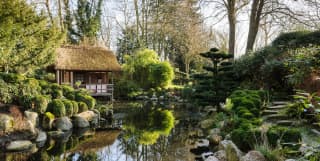
The Tea House is the ultimate destination of the routes. At the
door of the Tea House the visitors shake off “the dust of the
world”. The Tea House is built of plain English oak, thatched with
Norfolk reed with a bulrush ridge. Split hazel rods are used
throughout. The rough plastered walls are created with lime
plaster, a traditional technique, using boar and horse hair to bind
the plaster. The plaster will gradually weather to a soft glow.
Please remember to remove your shoes before stepping onto the
Tatami mats. The front door is the low Nigiriguchi
(crawling-in entrance). Its height ensures every guest offers a
gesture of humility toward the Tokonoma (alcove)
opposite. For the less brave, the Host door from the verandah may
be used. |
The essence of the Tea Garden expressed in an English setting is
offered here. It is a garden within a garden, a place of
tranquility and peace, imbued with Wabi (refined
poverty), Sabi (rusticity) and Yugen
(transcendent detachment). The Tea House is
named Fugetsu-An, (The Pavilion of a Deep Love of
Nature). Fugetsu is composed of the characters for
Wind and Moon. Fugetsu sounds like forgets, the
visitor is encouraged to forget the cares of the every day world
and become absorbed in the beauty of nature. Robert Ketchell – Designer
May 1995 |  |

|
|
 |
|
|